1100 Architect
475 10th Avenue
NY 10018 New York
T 212 645 1011
F 212 645 4670
contact@1100architect.com
facebook | twitter
475 10th Avenue
NY 10018 New York
T 212 645 1011
F 212 645 4670
contact@1100architect.com
facebook | twitter
Irish Hunger Memorial
Date: 2001
Location: Battery Park City, New York, NY
Owner: The Hugh L. Carey Battery Park City Authority
Scope: New construction, 16,320 sq. ft.
Schedule: Design: 2000-2001; Construction 2001-2002
The need to memorialize – to address events of the past and give form to what we value – is an enduring aspect of our culture. During the Great Irish Famine, approximately 12% of Ireland’s population died, and 15% emigrated from the island, many coming to the United States. The Irish Hunger Memorial recognizes these events by guiding the visitor through a process of learning, emotional reaction, and reflection.
A collaboration with artist Brian Tolle and landscape architect Gail Wittwer-Laird, this project consists of a base of Irish limestone and glass – inscribed with memorializing text and topped with a rugged Irish landscape. Walls of stone from Ireland’s 32 counties, native plants, and an authentic cottage in ruin are incorporated. Over time, the landscape of the monument will change and the texts will be updated. The monument is thus a living, evolving document that actively encourages visitors to meet the challenge of world hunger.
Location: Battery Park City, New York, NY
Owner: The Hugh L. Carey Battery Park City Authority
Scope: New construction, 16,320 sq. ft.
Schedule: Design: 2000-2001; Construction 2001-2002
The need to memorialize – to address events of the past and give form to what we value – is an enduring aspect of our culture. During the Great Irish Famine, approximately 12% of Ireland’s population died, and 15% emigrated from the island, many coming to the United States. The Irish Hunger Memorial recognizes these events by guiding the visitor through a process of learning, emotional reaction, and reflection.
A collaboration with artist Brian Tolle and landscape architect Gail Wittwer-Laird, this project consists of a base of Irish limestone and glass – inscribed with memorializing text and topped with a rugged Irish landscape. Walls of stone from Ireland’s 32 counties, native plants, and an authentic cottage in ruin are incorporated. Over time, the landscape of the monument will change and the texts will be updated. The monument is thus a living, evolving document that actively encourages visitors to meet the challenge of world hunger.
Townhouses Grüneburgweg
Date: 2010
Location: Frankfurt am Main, Westend-Süd, Grüneburgweg 39
Owner: Rainer Meininger und Rudolf Seibel
Scope: 1318 gross sq.m 928 net sq.m, 5 Townhouses (row-houses), concrete construction, with a wide opening in the southfacade, individual floor plans
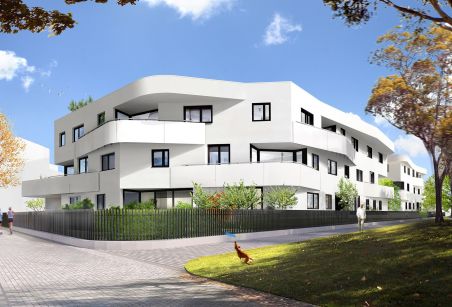
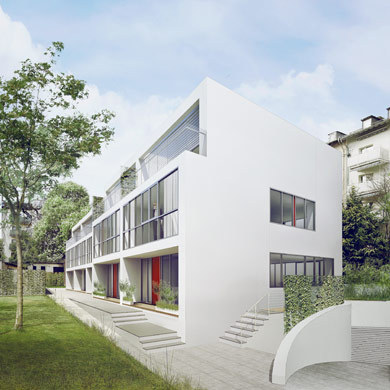
The design of five townhouses in a backyard of Grüneburgweg street provides inhabitants like young couples and families with an alternative to living in historical buildings. The flexible organization of the floor plan can adjust to the different needs of the residents. The houses include ample roof terrace and a green exterior space. The facades open completely to the east and to the west and, by this, feature plenty natural lightning. The underground garage gives the comfort of parking your car in close proximity to your residence.
Vizualization: © 1100 Architect
Location: Frankfurt am Main, Westend-Süd, Grüneburgweg 39
Owner: Rainer Meininger und Rudolf Seibel
Scope: 1318 gross sq.m 928 net sq.m, 5 Townhouses (row-houses), concrete construction, with a wide opening in the southfacade, individual floor plans
The design of five townhouses in a backyard of Grüneburgweg street provides inhabitants like young couples and families with an alternative to living in historical buildings. The flexible organization of the floor plan can adjust to the different needs of the residents. The houses include ample roof terrace and a green exterior space. The facades open completely to the east and to the west and, by this, feature plenty natural lightning. The underground garage gives the comfort of parking your car in close proximity to your residence.
Vizualization: © 1100 Architect
Queen’s Central Library and Children’s Library Discovery Center
Completion Date: 2011
Location: 89-11 Merrick Boulevard, Jamaica, NY 11432
Owner: Queens Library
Scope: 275,000 sq. ft. renovation of which 22,000 sq. ft. is new construction
Jamaica, NY, 2011 | Leed Silver Certification
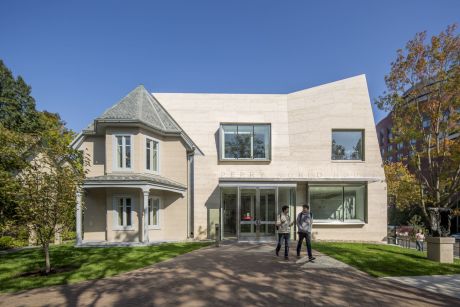
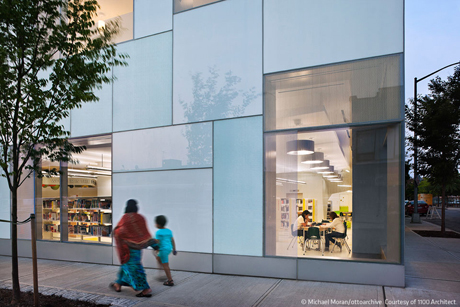
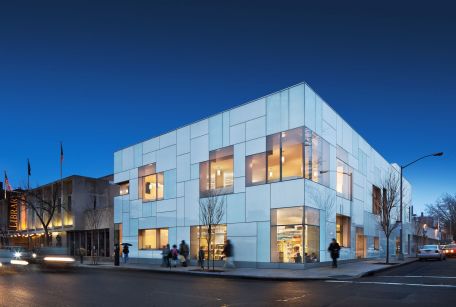
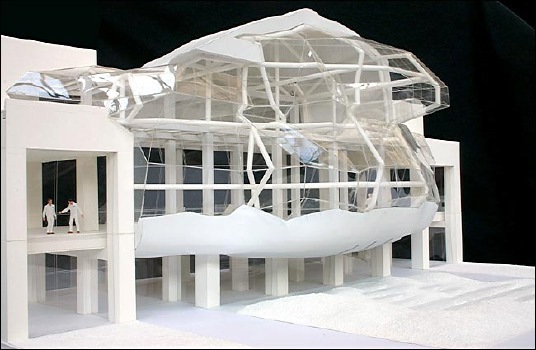
The design and construction of the Children’s Library Discovery Center (CLDC) is the implementation of one of the first phases of 1100 Architect’s master plan for the renovation and modernization of the 275,000-square-foot Queens Central Library. The CLDC is a 22,000-square-foot, two-story addition adjacent to the existing Central Library building. The glowing glass façade will be a beacon in the surrounding community and is elemental in increasing the library’s visibility and reintroducing it as a central cultural and social destination. Situated on a corner, the new addition takes advantage of its exposure to the street, creating a dialogue between the interior and exterior through the use of large transparent windows that allow an abundance of natural light to enter. The perimeter wall has been thickened to incorporate quiet reading nooks and intimate social spaces. This project will receive a LEED Silver rating.
Photos: © Michael Moran/ottoarchive / Courtesy of 1100 Architect
NYC Department of Design and Construction, Design and Construction Excellence Program
Queens Library Foundation, Award for Excellence in Design, 2011.
Queens Chamber of Commerce, Building Awards: New Construction / Public Building, 2011.
Public Design Commission of the City of New York, Design Award, 2007.Public Design Commission of the City of New York, Design Award, 2007.
Location: 89-11 Merrick Boulevard, Jamaica, NY 11432
Owner: Queens Library
Scope: 275,000 sq. ft. renovation of which 22,000 sq. ft. is new construction
Jamaica, NY, 2011 | Leed Silver Certification
The design and construction of the Children’s Library Discovery Center (CLDC) is the implementation of one of the first phases of 1100 Architect’s master plan for the renovation and modernization of the 275,000-square-foot Queens Central Library. The CLDC is a 22,000-square-foot, two-story addition adjacent to the existing Central Library building. The glowing glass façade will be a beacon in the surrounding community and is elemental in increasing the library’s visibility and reintroducing it as a central cultural and social destination. Situated on a corner, the new addition takes advantage of its exposure to the street, creating a dialogue between the interior and exterior through the use of large transparent windows that allow an abundance of natural light to enter. The perimeter wall has been thickened to incorporate quiet reading nooks and intimate social spaces. This project will receive a LEED Silver rating.
Photos: © Michael Moran/ottoarchive / Courtesy of 1100 Architect
NYC Department of Design and Construction, Design and Construction Excellence Program
Queens Library Foundation, Award for Excellence in Design, 2011.
Queens Chamber of Commerce, Building Awards: New Construction / Public Building, 2011.
Public Design Commission of the City of New York, Design Award, 2007.Public Design Commission of the City of New York, Design Award, 2007.
The New York Public Library, Battery Park City Branch
Date: March 2010
Location: One River Terrace, New York, NY
Owner: The New York Public Library
Scope: 10,500 square-foot facility anchoring the bottom two floors of a newly constructed residential tower
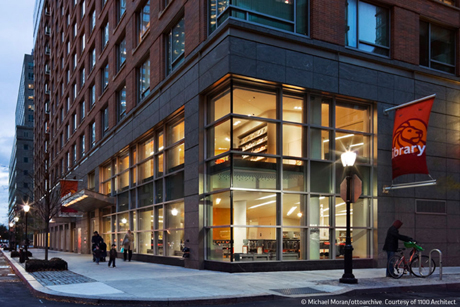
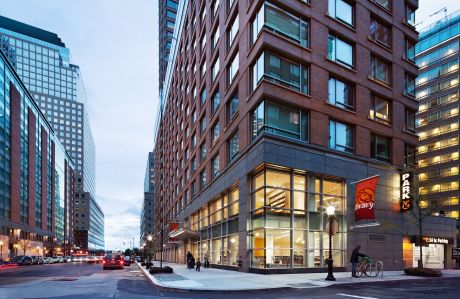
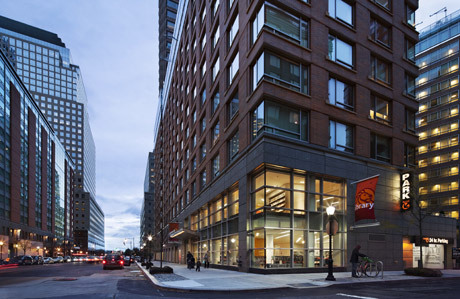
This 10,500-square-foot library, which occupies the bottom two floors of a residential highrise development in Battery Park City, was commissioned to meet the needs of a new and rapidly growing community. As a new branch without an ingrained pattern of community use, it was critical for the design to establish a presence that would attract visitors. Open, bright spaces create a welcoming environment for the public, while the design of book and periodical displays, information desks, and furniture facilitates the most efficient circulation. The folded planes of the ceiling guide the visitor’s eye through the library and acts as a physical and visual unifier for the entire space. The most eco-friendly of the New York Public Library branches, the project utilizes numerous sustainable design strategies and is on track to receive LEED Gold certification.
The National Terrazzo and Mosaic Association, Port Morris Tile and Marble Corporation Craftsmanship Award, The New York Public Library, Battery Park City Branch, 2011.
Interior Design, Best of Year Merit Award, The New York Public Library, Battery Park City Branch, 2010.
Contract, Public Space Interiors Award, 2012.
Photos: © Michael Moran/ottoarchive, Eduard Hueber- ArchPhoto
Location: One River Terrace, New York, NY
Owner: The New York Public Library
Scope: 10,500 square-foot facility anchoring the bottom two floors of a newly constructed residential tower
This 10,500-square-foot library, which occupies the bottom two floors of a residential highrise development in Battery Park City, was commissioned to meet the needs of a new and rapidly growing community. As a new branch without an ingrained pattern of community use, it was critical for the design to establish a presence that would attract visitors. Open, bright spaces create a welcoming environment for the public, while the design of book and periodical displays, information desks, and furniture facilitates the most efficient circulation. The folded planes of the ceiling guide the visitor’s eye through the library and acts as a physical and visual unifier for the entire space. The most eco-friendly of the New York Public Library branches, the project utilizes numerous sustainable design strategies and is on track to receive LEED Gold certification.
The National Terrazzo and Mosaic Association, Port Morris Tile and Marble Corporation Craftsmanship Award, The New York Public Library, Battery Park City Branch, 2011.
Interior Design, Best of Year Merit Award, The New York Public Library, Battery Park City Branch, 2010.
Contract, Public Space Interiors Award, 2012.
Photos: © Michael Moran/ottoarchive, Eduard Hueber- ArchPhoto
Long Island House
Date: April 2012
Location: Long Island, NY
Scope: Design and construction of residential house by the ocean. Demolish existing structure except partial wooden deck & walkway facing the ocean. Re-grade, reconfigure driveway up to new structure.
Schedule: 11/29/2007-4/30/2012
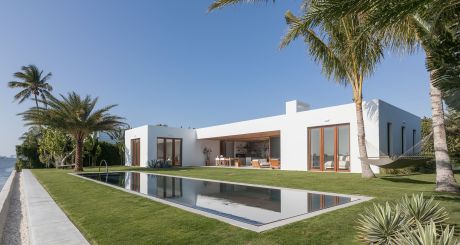
Situated on the eastern shore of Long Island, this weekend house is in a unique position to capture views of Lake Wickapogue and the ocean. The design optimizes the views by orienting the upper floor towards the lake and the bottom floor with maximum ocean frontage. The house includes a guest wing, staff wing, children’s suite, master suite, a pavilion with media room and gym, an open common area, eat-in kitchen, dining area, and three living spaces. A ramped green roof creates continuity by connecting the two floors and opening up the first floor to an open double height space. This core common area utilizes glass walls to let in an abundance of natural light and provide unobstructed views out to the front patio, across the infinity pool, to the dune and ocean beyond.
Visualization: © 1100 Architect
Location: Long Island, NY
Scope: Design and construction of residential house by the ocean. Demolish existing structure except partial wooden deck & walkway facing the ocean. Re-grade, reconfigure driveway up to new structure.
Schedule: 11/29/2007-4/30/2012
Situated on the eastern shore of Long Island, this weekend house is in a unique position to capture views of Lake Wickapogue and the ocean. The design optimizes the views by orienting the upper floor towards the lake and the bottom floor with maximum ocean frontage. The house includes a guest wing, staff wing, children’s suite, master suite, a pavilion with media room and gym, an open common area, eat-in kitchen, dining area, and three living spaces. A ramped green roof creates continuity by connecting the two floors and opening up the first floor to an open double height space. This core common area utilizes glass walls to let in an abundance of natural light and provide unobstructed views out to the front patio, across the infinity pool, to the dune and ocean beyond.
Visualization: © 1100 Architect
Naha City Gallery and Apartment House
Date: 2003
Location: Naha Fukotoshin, Okinawa, Japan
Owner: Yoko Higa Exsterstein
Scope: Design and construction of mixed-use residential building (6,900SF)
“Japanese music is above all a music of reticence, of atmosphere… In conversation, too, we prefer the soft voice, the understatement. Most important of all are the pauses.” – Jun’ichiro Tanizaki (I933)
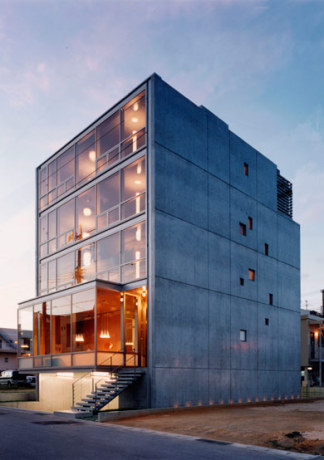
The Naha City Gallery and Apartment House was designed with subtlety and restraint. Rather than responding to the area’s strict seismic regulations with a bluntly communicated stability, we chose to resolve the challenge with elegantly tapered and reinforced concrete walls. Channels cut along their edges allow the space to breathe. Recalling ancient Japanese craftsmanship, the walls were poured in place using carefully constructed wooden molds. The humble beauty of the concrete becomes increasingly evident as it responds to light admitted by the varied fenestration. Ultimately, the space is quiet, refined, and open to the creative impulses of the user.
Photos: © Shinito Sato
Location: Naha Fukotoshin, Okinawa, Japan
Owner: Yoko Higa Exsterstein
Scope: Design and construction of mixed-use residential building (6,900SF)
“Japanese music is above all a music of reticence, of atmosphere… In conversation, too, we prefer the soft voice, the understatement. Most important of all are the pauses.” – Jun’ichiro Tanizaki (I933)
The Naha City Gallery and Apartment House was designed with subtlety and restraint. Rather than responding to the area’s strict seismic regulations with a bluntly communicated stability, we chose to resolve the challenge with elegantly tapered and reinforced concrete walls. Channels cut along their edges allow the space to breathe. Recalling ancient Japanese craftsmanship, the walls were poured in place using carefully constructed wooden molds. The humble beauty of the concrete becomes increasingly evident as it responds to light admitted by the varied fenestration. Ultimately, the space is quiet, refined, and open to the creative impulses of the user.
Photos: © Shinito Sato
MoMA Design Store, Soho
Date: 2001
Location: 81 Spring Street, New York, NY
Owner: Museum of Modern Art
Scope: Program, planning, design and construction of 11,000 sq. ft. interior of a historic landmark building.
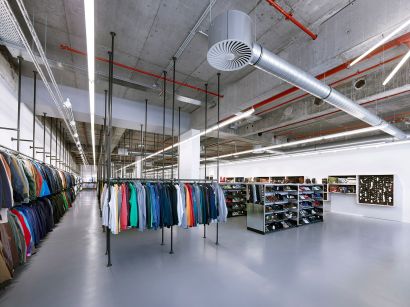
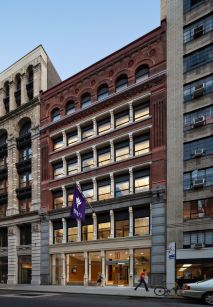
Three years after beginning the first MoMA Design Store across from the Midtown museum, we initiated designs for the satellite store in SoHo. Incorporating the historic physical attributes of the landmark building – its cast-iron columns, maple flooring, and open loft layout – was critical. The link between SoHo’s physical environment and the Museum is strong, forged by the many artists who made their studios in SoHo lofts in the 1980s. The design of this store solidifies that link. Carefully introducing new materials such as glass and polyvinyl with a comprehensive, ethereal lighting scheme bred a provocative and dynamic theater for design goods. It contributes both to the cultural presence of the MoMA and to the vibrancy of its urban context.
Photos: © Peter Aaron ESTO
Location: 81 Spring Street, New York, NY
Owner: Museum of Modern Art
Scope: Program, planning, design and construction of 11,000 sq. ft. interior of a historic landmark building.
Three years after beginning the first MoMA Design Store across from the Midtown museum, we initiated designs for the satellite store in SoHo. Incorporating the historic physical attributes of the landmark building – its cast-iron columns, maple flooring, and open loft layout – was critical. The link between SoHo’s physical environment and the Museum is strong, forged by the many artists who made their studios in SoHo lofts in the 1980s. The design of this store solidifies that link. Carefully introducing new materials such as glass and polyvinyl with a comprehensive, ethereal lighting scheme bred a provocative and dynamic theater for design goods. It contributes both to the cultural presence of the MoMA and to the vibrancy of its urban context.
Photos: © Peter Aaron ESTO
Main: Eastside Lofts
Date: March 2012
Location: Osthafenplatz 6-8, Frankfurt, Germany
Owner: Premium Estate Group (PEG) Loft Frankfurt GmbH & Co.
Scope: Renovation and addition totaling 14,800 sq m
Schedule: Design 2009-2010; Construction 2010-2012
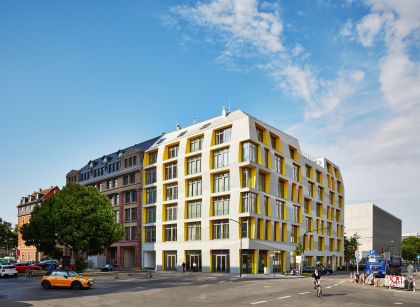
This project is a dynamic exploration of the relationship between a historic, neoclassical building and a contemporary addition within the context of a rapidly developing neighborhood in Frankfurt. While designed in a contemporary style, the addition creates a cohesive whole with the existing landmarked building by corresponding to the volume, rhythm, and proportions of the original. It also takes on the generous floor-to-floor height of the prewar structure and the angular shape of its mansard roof. The addition departs from the neoclassical design of the existing building through the use of a sculpturally folded concrete façade punctured by large openings, balconies and loggias, and the playful use of color. 1100 is also working on the renovation of the existing building.
Visualization: © Archimation
Location: Osthafenplatz 6-8, Frankfurt, Germany
Owner: Premium Estate Group (PEG) Loft Frankfurt GmbH & Co.
Scope: Renovation and addition totaling 14,800 sq m
Schedule: Design 2009-2010; Construction 2010-2012
This project is a dynamic exploration of the relationship between a historic, neoclassical building and a contemporary addition within the context of a rapidly developing neighborhood in Frankfurt. While designed in a contemporary style, the addition creates a cohesive whole with the existing landmarked building by corresponding to the volume, rhythm, and proportions of the original. It also takes on the generous floor-to-floor height of the prewar structure and the angular shape of its mansard roof. The addition departs from the neoclassical design of the existing building through the use of a sculpturally folded concrete façade punctured by large openings, balconies and loggias, and the playful use of color. 1100 is also working on the renovation of the existing building.
Visualization: © Archimation
House in Taunus
Date: November 2009
Location: Bad Soden am Taunus, Germany
Owner: Private
Scope: Design and construction of 150 square meter residence
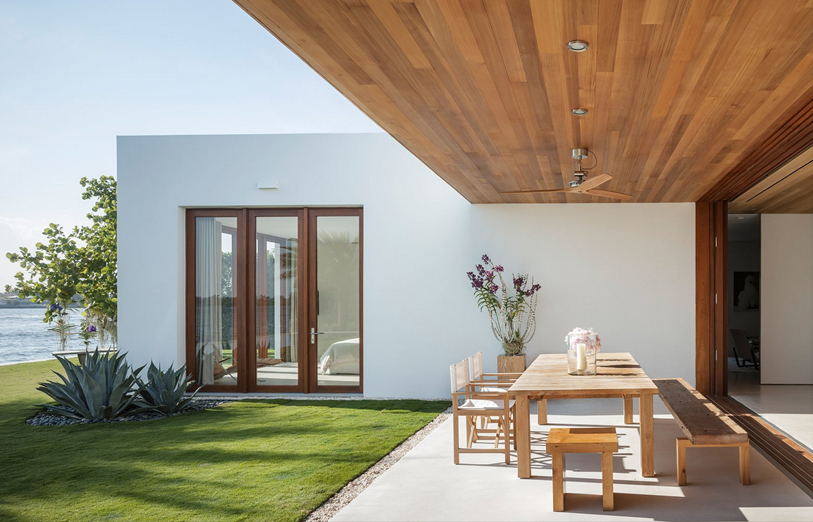
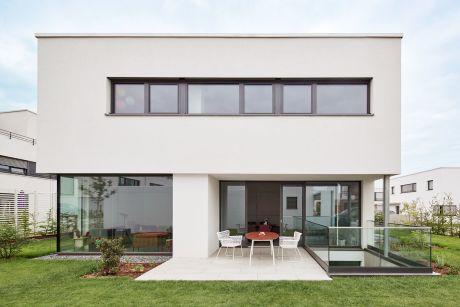
This hillside property has spectacular views of meadows, apple orchards, and the dense forests of the Taunus Mountains. The building consists of two rectangular units stacked, slightly shifted, one on top of the other. Only the slender entrance is visible from the street, while the rest of the house retreats into the hillside. The façade opens up to the west, which due to its low angle, allows sun to enter the building and heat the rooms in the winter; trees provide shade and protection against overheating in the summer.
Photos:
© Nikolas Koenig
© Axel Schneider
© 1100 Architect
Courtesy of 1100 Architect
Location: Bad Soden am Taunus, Germany
Owner: Private
Scope: Design and construction of 150 square meter residence
This hillside property has spectacular views of meadows, apple orchards, and the dense forests of the Taunus Mountains. The building consists of two rectangular units stacked, slightly shifted, one on top of the other. Only the slender entrance is visible from the street, while the rest of the house retreats into the hillside. The façade opens up to the west, which due to its low angle, allows sun to enter the building and heat the rooms in the winter; trees provide shade and protection against overheating in the summer.
Photos:
© Nikolas Koenig
© Axel Schneider
© 1100 Architect
Courtesy of 1100 Architect
Brooklyn Detention Center
Date: February 2010
Location: 275 Atlantic Avenue. Brooklyn, NY
Owner: The New York City Department of Corrections
Scope: Renovation and expansion of existing detention center
Schedule: Design 2010
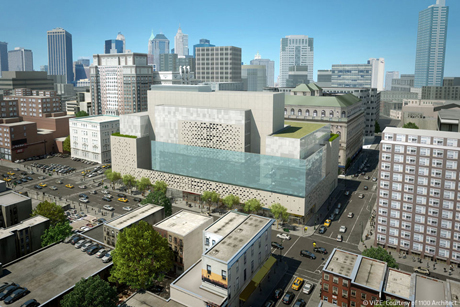
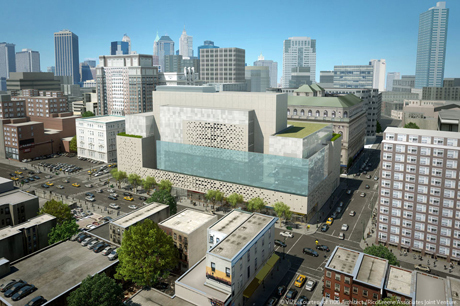
The 1100 Architect / RicciGreene Associates Joint Venture proposed renovation and expansion of the Brooklyn Detention Center (BDC) would transform the aging jail into a state-of-the-art, 21st-century civic landmark. The design is informed by five key factors: creating a building of design excellence and high performance energy efficiency; replacing an artifact from another era with a new paradigm in Brooklyn’s civic and commercial center; addressing key concerns of the neighboring community; introducing best practices to provide humane, normative environments for detainees; and providing a safe and secure environment, both inside the building and within the urban context. The design is a carefully balanced composition, juxtaposing the lightness of the glass curtain wall with the mass of perforated concrete volumes to provide maximum light, air, and security throughout the building.
Sustainability is a key component of the design. Designed to achieve LEED Silver certification, green elements explored include a green roof, water conservation, and energy efficient climate control. Incorporating high-performance, sustainable strategies would provide environmental benefits for the Brooklyn community and long-term operational cost savings for the City of New York.
Visualization: © VIZE / Courtesy of 1100 Architect/Ricci Greene Associates Joint Venture
AIA NY Chapter, Merit Award - Unbuilt Work, 2012
Location: 275 Atlantic Avenue. Brooklyn, NY
Owner: The New York City Department of Corrections
Scope: Renovation and expansion of existing detention center
Schedule: Design 2010
The 1100 Architect / RicciGreene Associates Joint Venture proposed renovation and expansion of the Brooklyn Detention Center (BDC) would transform the aging jail into a state-of-the-art, 21st-century civic landmark. The design is informed by five key factors: creating a building of design excellence and high performance energy efficiency; replacing an artifact from another era with a new paradigm in Brooklyn’s civic and commercial center; addressing key concerns of the neighboring community; introducing best practices to provide humane, normative environments for detainees; and providing a safe and secure environment, both inside the building and within the urban context. The design is a carefully balanced composition, juxtaposing the lightness of the glass curtain wall with the mass of perforated concrete volumes to provide maximum light, air, and security throughout the building.
Sustainability is a key component of the design. Designed to achieve LEED Silver certification, green elements explored include a green roof, water conservation, and energy efficient climate control. Incorporating high-performance, sustainable strategies would provide environmental benefits for the Brooklyn community and long-term operational cost savings for the City of New York.
Visualization: © VIZE / Courtesy of 1100 Architect/Ricci Greene Associates Joint Venture
AIA NY Chapter, Merit Award - Unbuilt Work, 2012